MindSave Official Website › Notebook › Phosphatidylserine's Other Research Thread
Phosphatidylserine's Other Research Thread
Phosphatidylserine's memory trials get most of the attention on a cognition label: a 1991 bovine-sourced trial, a 2001 soy-derived trial that found nothing, and the FDA qualified health claim built partly on both. A separate, smaller literature asked a completely different question — not whether phosphatidylserine helps you remember, but whether it blunts the stress hormone response to hard exercise.
- Different question entirely. This thread measured cortisol, testosterone, exercise time-to-exhaustion and muscle damage markers in young athletic men, not memory scores in older adults.
- One study found a real cortisol effect. Ten days of 600 mg a day cut peak cortisol by roughly 39% after moderate exercise.
- Two follow-up studies did not replicate it. Two later trials, at 750 mg a day, found no cortisol effect at all, despite one of them showing an improvement in time to exhaustion.
- None of it is about cognition. These trials say nothing about memory, focus or anything on MindSave's own ingredients page.
A different question entirely
Phosphatidylserine is a phospholipid found in every cell membrane, and its memory-and-aging research is the thread most cognition labels borrow from: the 1991 trial in bovine-sourced material, the 2001 null result in the soy-derived form now actually sold, and the FDA's qualified health claim built from a mix of both. None of that research asked what phosphatidylserine does during and after physical exertion in young, healthy, athletic men. A separate set of sport-science trials from the mid-2000s did ask exactly that, and their outcome measures — cortisol, testosterone, lactate, growth hormone, time to exhaustion, muscle-damage markers — have nothing to do with memory or focus at all.
That distinction matters because a shopper who sees “phosphatidylserine, studied in clinical trials” on a cognition label has no way of knowing, from the ingredient name alone, which of two entirely separate research bodies is being gestured at. This page covers the exercise-and-cortisol thread on its own terms.
The study that found a cortisol effect
A 2008 study in the Journal of the International Society of Sports Nutrition gave ten healthy male subjects 600 mg of phosphatidylserine or a placebo daily for ten days, in a double-blind, placebo-controlled crossover design, then measured blood cortisol, growth hormone, testosterone and lactate before, during and after fifteen minutes of moderate-intensity cycling that stepped from 65% to 85% of VO2 max. Peak cortisol concentration and the area under the cortisol curve were both lower following phosphatidylserine — by roughly 39% and 35% respectively — compared with placebo. The testosterone-to-cortisol ratio, a marker sometimes used as a rough proxy for recovery balance, rose by about 184% on the same measure. Lactate and growth hormone were unaffected either way. The authors' own conclusion was that phosphatidylserine looked like an effective way to blunt the cortisol response to exercise stress and support a hormonal profile favourable to athletes.
Two studies that did not replicate it
Two related trials from a different research group, published the year before and the year after, used a higher dose and did not find the same cortisol effect.
The earlier of the two, in 2005, gave sixteen male soccer players 750 mg of soybean-derived phosphatidylserine or a glucose-polymer placebo daily for ten days before an exhaustive intermittent running protocol designed to mimic match play. Serum cortisol, perceived soreness, and markers of muscle damage and lipid peroxidation all rose to a similar extent whether subjects had taken phosphatidylserine or placebo — supplementation did not blunt any of them. Running time to exhaustion moved in a favourable direction, up 4.2% after phosphatidylserine against a 3.7% decline after placebo, but that difference fell short of statistical significance (p = 0.084).
The later trial, in 2006, gave fourteen active men the same 750 mg daily dose for ten days before a staged cycling protocol ending in an exhaustive bout at 85% VO2 max. This time the performance result reached significance: time to exhaustion rose from just under eight minutes to just under ten minutes after phosphatidylserine, while the placebo group was unchanged (p = 0.001 for the change within the phosphatidylserine group). But serum cortisol, oxygen-uptake kinetics and subjective feeling states were not significantly affected by supplementation in this trial either. The authors called it the first study to report improved exercise capacity following phosphatidylserine, while explicitly noting their cortisol result did not match the 2008 finding.
| Study | Dose & duration | Cortisol effect? | Performance effect? |
|---|---|---|---|
| Starks et al., 2008 | 600 mg/day, 10 days, n=10 | Yes — peak cortisol down ~39% | Not measured |
| Kingsley et al., 2005 | 750 mg/day, 10 days, n=16 | No effect | Trend only (p=0.084) |
| Kingsley et al., 2006 | 750 mg/day, 10 days, n=14 | No effect | Yes — time to exhaustion up (p=0.001) |
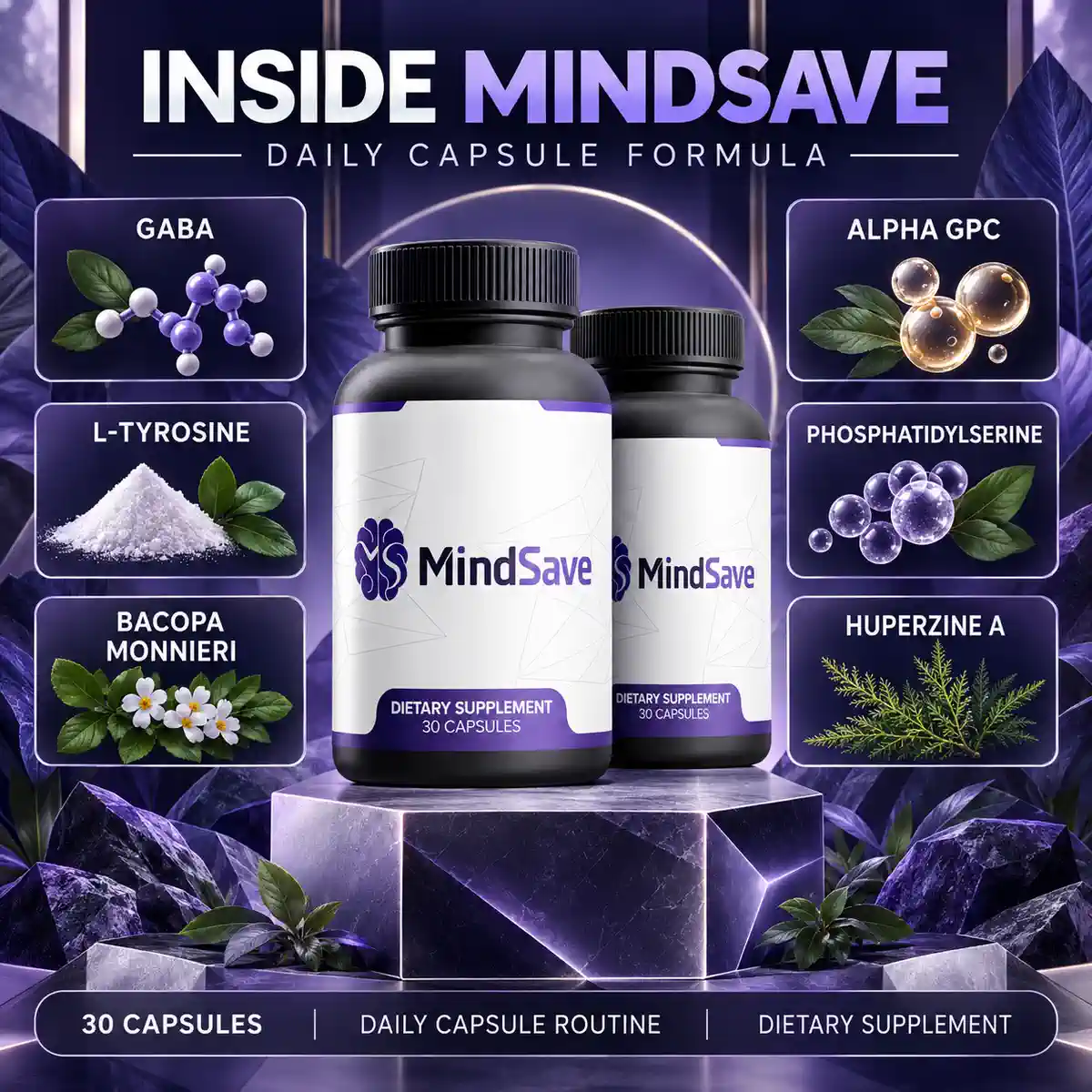
Doses and results are what each cited paper reports. None of them describes MindSave, which prints no amount for phosphatidylserine or any of its other seven names.
MindSave, on the official website
One capsule a day, thirty to a bottle, eight ingredients named on the label. Sixty days to change your mind, and the bottles go back even if they are empty.
Order MindSaveWhat the three studies add up to
Three small trials, all ten days, all in young athletic men, and they do not agree with each other on the mechanism even where they agree on part of the outcome. The 2008 trial found the cortisol-blunting effect its authors were looking for, at a lower dose, in a shorter, milder exercise protocol than the two follow-up trials used. Both follow-up trials, at a higher dose and a harder exercise protocol, found a performance benefit — one of them statistically significant, one only a trend — without the cortisol change that was supposed to be the mechanism behind it. Read honestly, that leaves phosphatidylserine's exercise-hormone story unsettled: something in these three small studies looks real, given that two out of three found a performance-adjacent result, but which physiological lever is doing the work is not the same answer across all three papers.
That is worth holding onto specifically because it is the opposite problem from most of phosphatidylserine's memory literature, where the 1991 bovine-sourced trial found benefit and the 2001 soy-derived trial found none. Here, the direction of the performance finding is more consistent than the underlying mechanism, which is a different and, if anything, harder pattern to interpret cleanly.
Why the dose and source matter here too
All three trials used a specific, disclosed amount — 600 or 750 mg a day — of a named source, soybean-derived phosphatidylserine, taken daily for a fixed ten-day loading period before the exercise test. Every one of those details is printed in the paper because it is part of what makes the finding checkable and repeatable. MindSave's sales page names phosphatidylserine among its eight ingredients and states none of those details: no milligram amount, no stated loading period, and no claim tying it to exercise or cortisol at all. The label page covers why none of the eight names on this sales page carry a printed amount.
It is also worth noting plainly that none of these three trials tested anything resembling MindSave's own marketing claims of sharper memory or clearer focus. They tested physically active young men under an acute training stimulus, not cognitive performance in anyone, at rest or otherwise. Borrowing the general phrase “phosphatidylserine is studied in clinical trials” to support a memory claim, while the actual trial behind that phrase measured a cyclist's cortisol level, would be stretching the citation well past what it can support.
The population gap runs the other way too. All three exercise trials recruited young, physically active or athletic men — college soccer players, trained cyclists, active adults in their twenties. The memory-and-aging trials on this same ingredient recruited people over 50 or 57 with age-related memory concerns. Neither population tells you much about the other, and a cognition-supplement buyer reading “phosphatidylserine” on a label is, most of the time, neither a competitive athlete mid-training-block nor a clinical-trial participant with diagnosed age-associated memory impairment. The research base, in other words, was not built with this exact reader in mind either way.
What this has to do with a cognition capsule
The honest summary is narrow on purpose. Phosphatidylserine has a second, smaller research thread beyond the memory-and-aging trials already covered on this website, and that thread is about physical exercise, not cognition. It is inconsistent even on its own terms — one trial found the cortisol effect its design was built to detect, two later trials at a higher dose did not, even while finding a performance benefit through some other route. None of the three trials has any bearing on the memory or focus claims a cognition-supplement label typically makes for this ingredient, and none of them describes a finished product like MindSave, whose own page discloses no amount for phosphatidylserine at all.
The vitamins page in this notebook covers a different pair of names on the same label; the qualified health claim page covers phosphatidylserine's actual memory-trial record and the FDA language built from it.
Two research threads, two populations, two sets of outcome measures, one ingredient name on one label. Keeping them separate is not a criticism of phosphatidylserine as a compound; it is simply what an accurate reading of the published record requires, and it is the same standard this notebook tries to apply to every name on this sales page.
A note on what this is. MindSave is a dietary supplement, not a medicine. Nothing in this post describes it as a treatment for any condition, athletic or cognitive. The trials described above studied phosphatidylserine as a standalone supplement in healthy exercising men, not this product, which has not been the subject of a published clinical trial and states no amount for any of its eight ingredients.
Sources cited in this article
- Starks MA, Starks SL, Kingsley M, Purpura M, Jäger R. The effects of phosphatidylserine on endocrine response to moderate intensity exercise. J Int Soc Sports Nutr. 2008;5:11. PMID 18662395. https://pubmed.ncbi.nlm.nih.gov/18662395/
- Kingsley MI, Wadsworth D, Kilduff LP, McEneny J, Benton D. Effects of phosphatidylserine on oxidative stress following intermittent running. Med Sci Sports Exerc. 2005;37(8):1300-6. PMID 16118575. https://pubmed.ncbi.nlm.nih.gov/16118575/
- Kingsley MI, Miller M, Kilduff LP, McEneny J, Benton D. Effects of phosphatidylserine on exercise capacity during cycling in active males. Med Sci Sports Exerc. 2006;38(1):64-71. PMID 16394955. https://pubmed.ncbi.nlm.nih.gov/16394955/
- Crook TH, Tinklenberg J, Yesavage J, Petrie W, Nunzi MG, Massari DC. Effects of phosphatidylserine in age-associated memory impairment. Neurology. 1991;41(5):644-9. PMID 2027477. https://pubmed.ncbi.nlm.nih.gov/2027477/
- Jorissen BL, Brouns F, Van Boxtel MP, Ponds RW, Verhey FR, Jolles J, Riedel WJ. The influence of soy-derived phosphatidylserine on cognition in age-associated memory impairment. Nutr Neurosci. 2001;4(2):121-34. PMID 11842880. https://pubmed.ncbi.nlm.nih.gov/11842880/
MindSave, on the official website
One capsule a day, thirty to a bottle, eight ingredients named on the label. Sixty days to change your mind, and the bottles go back even if they are empty.
Order MindSave