MindSave Official Website › MindSave Ingredients
MindSave Ingredients: The Eight On The Sales Page
The MindSave sales page lists eight ingredients and no amounts: niacin as niacinamide, vitamin B6, GABA, L-tyrosine, bacopa monnieri, alpha GPC, phosphatidylserine and huperzine A. A second published document, the printed label artwork, gives amounts for a different formula, and this page is about the first of the two.
It takes the eight in turn. Both lists are set side by side on the supplement facts page, which is where the difference between them is worked through.
The eight ingredients on the MindSave sales page
Four of the eight arrived with a photograph in the supplier's image pack.
Niacin (as Niacinamide)
vitaminNiacinamide is one of the two forms of vitamin B3 and the one that does not produce the skin flush nicotinic acid is known for. It is a nutrient with an established daily value, which makes it the most ordinary name on this list.
Vitamin B6
vitaminVitamin B6 appears on the seller's list and again on the label panel artwork, which is one of only three names the two documents agree on. It is a routine nutrient and the amount is the part worth knowing, because B6 is one of the few vitamins with a recognised upper intake level.
GABA
amino acidGamma-aminobutyric acid is made in the body and also sold as a supplement ingredient. It is usually associated with calm rather than with recall, and it is the name on this list most often chosen for how a formula is meant to feel rather than for what it is meant to do.
L-Tyrosine
amino acidL-tyrosine is a dietary amino acid and a building block the body uses to make several signalling chemicals. Research on it clusters around performance under pressure rather than around everyday memory.
Bacopa Monnieri
botanicalBacopa monnieri is the botanical on this list with the longest clinical record in memory research, and also the one that most consistently takes weeks rather than days to show anything. Which plant part and which standardisation are used here is a question the seller's list does not answer.
Alpha GPC
choline compoundAlpha-glycerylphosphorylcholine is a source of choline. It is one of the two names the seller's own artwork gives the most room to, and it is a compound whose form matters: alpha GPC and choline bitartrate are not interchangeable.
Phosphatidylserine
phospholipidPhosphatidylserine is a structural fat found in every cell membrane and concentrated in nerve tissue. Supplement versions are usually derived from soy or sunflower, and the seller's list does not say which.
Huperzine A
plant alkaloidHuperzine A is a purified compound from Huperzia serrata, and it is the name on this list that behaves least like a nutrient. It is the one a reader should raise with a prescriber before anything else on the label, and the one this website is most careful about: nothing here describes it as a treatment for anything.
What published trials used, beside what the MindSave sales page gives
| Ingredient, as the sales page lists it | What studies used | What the sales page gives |
|---|---|---|
| Niacin (as Niacinamide) | The adult RDA is 16 mg NE for men and 14 mg NE for women, and the Tolerable Upper Intake Level for supplemental niacin is 35 mg a day. Niacinamide is the form that does not cause flushing. | Not published |
| Vitamin B6 | The adult RDA is 1.3 mg to age 50, then 1.7 mg for men and 1.5 mg for women, and the Tolerable Upper Intake Level is 100 mg a day from food and supplements together. Sensory neuropathy is documented at 1 to 6 g a day taken for 12 to 40 months. | Not published |
| GABA | 20 to 300 mg per dose in the human trials a systematic review could find, from single doses up to eight weeks. USP found no serious adverse events at 120 mg a day for 12 weeks. | Not published |
| L-Tyrosine | 2 g a day for five days in the combat-course trial, and 150 mg per kg of body weight as a single dose in the study of older adults. The positive findings cluster in short, acutely stressful or cognitively demanding situations rather than ordinary days. | Not published |
| Bacopa Monnieri | 300 to 450 mg a day of a standardised extract, and every trial in the systematic review ran for twelve weeks. The meta-analysis would not admit a trial shorter than twelve weeks at all. | Not published |
| Alpha GPC | 250 mg, 315 mg, 500 mg and 630 mg in the trials run in healthy adults. Europe's food-safety regulator has assessed 203.7 mg a day as a supplement level. | Not published |
| Phosphatidylserine | 300 mg a day - 100 mg three times daily - for twelve weeks in the 1991 trial that used the bovine-cortex form, and 300 or 600 mg a day for twelve weeks in the trial of the soy-derived form sold today, which found no difference from placebo on any measure. | Not published |
| Huperzine A | 200 or 400 MICROGRAMS twice a day for at least sixteen weeks in the largest placebo-controlled trial - micrograms, not milligrams, which is the smallest quantity on this panel by three orders of magnitude. That trial's primary analysis found no cognitive effect at the lower dose. | Not published |
The middle column describes published research on each ingredient. It is not a description of this capsule, and nothing on this website moves a figure from it into the column beside it. Huperzine A is in micrograms, a thousandth of a milligram.
The useful thing in that table is not any single row. It is the range. Bacopa's trials are measured in hundreds of milligrams and huperzine A's in hundreds of micrograms, which is a thousand-fold difference, and a list of eight names reads exactly the same whichever end of that range each one sits at. That is the honest limit of a name without a number, and it is why this page is organised around what a name can still do rather than around what is missing.
Which MindSave ingredient has the strongest evidence, and which the weakest
Bacopa monnieri is the strongest, and it is worth saying why: its trials were run in adults without cognitive impairment, which is the population buying this product, and the review reports a real if narrow finding, on free recall and mostly nowhere else. The twelve-week randomised trial also reported its side effects rather than glossing them.
Huperzine A is the weakest, and for an unusual reason. Cochrane looked for placebo-controlled trials in mild cognitive impairment and found none eligible at all. That is an absence of evidence in both directions: it does not show the ingredient does nothing, and it does not show it is unsafe. It shows the question has not been answered.
One trial on this panel gave two of these eight ingredients to the same people. It gave GABA and tyrosine together to healthy volunteers, and found that GABA alone, and GABA with tyrosine, made task switching worse. The authors call it preliminary and the arms were twelve people each. It belongs on this page anyway.
MindSave ingredient questions
How many ingredients are in MindSave?
Eight are named on the label: niacin as niacinamide, vitamin B6, GABA, L-tyrosine, bacopa monnieri, alpha GPC, phosphatidylserine and huperzine A.
Which MindSave ingredient has the best evidence?
Bacopa monnieri. The systematic review that collected its trials found it improved free recall on nine of seventeen memory tests, in adults without cognitive impairment, and every trial ran twelve weeks.
Which MindSave ingredient has the least?
Huperzine A. Cochrane searched for randomised, placebo-controlled trials in mild cognitive impairment and found none that met its criteria, which is an absence of evidence rather than a negative result.
Does MindSave contain caffeine?
This desk cannot tell you. The sales-page list carries none; the printed label artwork carries caffeine from green coffee with theacrine and theobromine beside it. The label page prints both and asserts neither.
How this MindSave ingredient page is written
Four claims, and they are the ones a sceptical reader can audit in ten minutes:
- The bottle is the source. The eight names, the capsule count, the serving direction and the caution block come from the printed label and the supplier’s artwork. Prices, shipping lines, bonus titles and the guarantee wording come from the seller’s own order page, read on 19 September 2026.
- Research amounts live in a column of their own, headed “What studies used”, beside a column that says what the label prints. No sentence here moves a number from the first into the second.
- Sources are cited against their own population. Where a trial was run in people with a diagnosis, the sentence says so and the result is not carried across to a healthy reader.
- Corrections change the date. Write to [email protected] and the review date moves forward.
We earn when you buy. Themindsave is the USA Authorized MindSave Retailer named at the top of this page and this website makes money on orders placed through it. That is exactly why the note on what a list of eight names is worth, the three-star reviews and the plain statement that MindSave is not a treatment for anything are here: they are where our interest and yours pull apart. Order support on +1 (302) 200-3480 handles tracking, changes and refunds and is never a way to place an order; orders go through the checkout only.
Sources for the MindSave ingredient list
- NIH Office of Dietary Supplements. Niacin: Fact Sheet for Health Professionals. https://ods.od.nih.gov/factsheets/Niacin-HealthProfessional/
- NIH Office of Dietary Supplements. Vitamin B6: Fact Sheet for Health Professionals. https://ods.od.nih.gov/factsheets/VitaminB6-HealthProfessional/
- Hepsomali P, Groeger JA, Nishihira J, Scholey A. Effects of Oral Gamma-Aminobutyric Acid (GABA) Administration on Stress and Sleep in Humans: A Systematic Review. Front Neurosci. 2020;14:923. PMID 33041752. https://pubmed.ncbi.nlm.nih.gov/33041752/
- Kakee A, Takanaga H, Terasaki T, Naito M, Tsuruo T, Sugiyama Y. Efflux of a suppressive neurotransmitter, GABA, across the blood-brain barrier. J Neurochem. 2001;79(1):110-8. PMID 11595763. https://pubmed.ncbi.nlm.nih.gov/11595763/
- Oketch-Rabah HA, Madden EF, Roe AL, Betz JM. United States Pharmacopeia (USP) Safety Review of Gamma-Aminobutyric Acid (GABA). Nutrients. 2021;13(8):2742. PMID 34444905. https://pubmed.ncbi.nlm.nih.gov/34444905/
- Lim LW, Aquili L. GABA Supplementation Negatively Affects Cognitive Flexibility Independent of Tyrosine. J Clin Med. 2021;10(9):1807. PMID 33919136. https://pubmed.ncbi.nlm.nih.gov/33919136/
- Attipoe S, Zeno SA, Lee C, Crawford C, Khorsan R, Walter AR, Deuster PA. Tyrosine for Mitigating Stress and Enhancing Performance in Healthy Adult Humans, a Rapid Evidence Assessment of the Literature. Mil Med. 2015;180(7):754-65. PMID 26126245. https://pubmed.ncbi.nlm.nih.gov/26126245/
- Deijen JB, Wientjes CJ, Vullinghs HF, Cloin PA, Langefeld JJ. Tyrosine improves cognitive performance and reduces blood pressure in cadets after one week of a combat training course. Brain Res Bull. 1999;48(2):203-9. PMID 10230711. https://pubmed.ncbi.nlm.nih.gov/10230711/
- Bloemendaal M, Frobose MI, Wegman J, Zandbelt BB, van de Rest O, Cools R, Aarts E. Neuro-Cognitive Effects of Acute Tyrosine Administration on Reactive and Proactive Response Inhibition in Healthy Older Adults. eNeuro. 2018;5(2):ENEURO.0035-17.2018. PMID 30094335. https://pubmed.ncbi.nlm.nih.gov/30094335/
- Pase MP, Kean J, Sarris J, Neale C, Scholey AB, Stough C. The cognitive-enhancing effects of Bacopa monnieri: a systematic review of randomized, controlled human clinical trials. J Altern Complement Med. 2012;18(7):647-52. PMID 22747190. https://pubmed.ncbi.nlm.nih.gov/22747190/
- Kongkeaw C, Dilokthornsakul P, Thanarangsarit P, Limpeanchob N, Norman Scholfield C. Meta-analysis of randomized controlled trials on cognitive effects of Bacopa monnieri extract. J Ethnopharmacol. 2014;151(1):528-35. PMID 24252493. https://pubmed.ncbi.nlm.nih.gov/24252493/
- Calabrese C, Gregory WL, Leo M, Kraemer D, Bone K, Oken B. Effects of a standardized Bacopa monnieri extract on cognitive performance, anxiety, and depression in the elderly: a randomized, double-blind, placebo-controlled trial. J Altern Complement Med. 2008;14(6):707-13. PMID 18611150. https://pubmed.ncbi.nlm.nih.gov/18611150/
- Marcus L, Soileau J, Judge LW, Bellar D. Evaluation of the effects of two doses of alpha glycerylphosphorylcholine on physical and psychomotor performance. J Int Soc Sports Nutr. 2017;14:39. PMID 29042830. https://pubmed.ncbi.nlm.nih.gov/29042830/
- Kerksick CM. Acute Alpha-Glycerylphosphorylcholine Supplementation Enhances Cognitive Performance in Healthy Men. Nutrients. 2024;16(23):4240. PMID 39683633. https://pubmed.ncbi.nlm.nih.gov/39683633/
- EFSA Panel on Nutrition, Novel Foods and Food Allergens (NDA); Turck D, Bohn T, Camara M, et al. Safety of L-alpha-glycerylphosphorylcholine (L-alpha-GPC) from soya phospholipids (lecithin) as a novel food pursuant to Regulation (EU) 2015/2283. EFSA J. 2026;24(5):e10008. PMID 42131868. https://pubmed.ncbi.nlm.nih.gov/42131868/
- Lee G, Choi S, Chang J, Choi D, Son JS, Kim K, Kim SM, Jeong S, Park SM. Association of L-alpha Glycerylphosphorylcholine With Subsequent Stroke Risk After 10 Years. JAMA Netw Open. 2021;4(11):e2136008. PMID 34817582. https://pubmed.ncbi.nlm.nih.gov/34817582/
- Kim HK, Park S, Kim SW, Park ES, Hong JY, Hong I, Baek MS. Association between L-alpha glycerylphosphorylcholine use and delayed dementia conversion: A nationwide longitudinal study in South Korea. J Prev Alzheimers Dis. 2025;12(4):100059. PMID 40155153. https://pubmed.ncbi.nlm.nih.gov/40155153/
- U.S. Food and Drug Administration, Center for Food Safety and Applied Nutrition. Letter of enforcement discretion - Phosphatidylserine and Cognitive Dysfunction and Dementia, 13 May 2003. FDA web archive. http://wayback.archive-it.org/7993/20171114183649/https://www.fda.gov/Food/IngredientsPackagingLabeling/LabelingNutrition/ucm072999.htm
- Crook TH, Tinklenberg J, Yesavage J, Petrie W, Nunzi MG, Massari DC. Effects of phosphatidylserine in age-associated memory impairment. Neurology. 1991;41(5):644-9. PMID 2027477. https://pubmed.ncbi.nlm.nih.gov/2027477/
- Jorissen BL, Brouns F, Van Boxtel MP, Ponds RW, Verhey FR, Jolles J, Riedel WJ. The influence of soy-derived phosphatidylserine on cognition in age-associated memory impairment. Nutr Neurosci. 2001;4(2):121-34. PMID 11842880. https://pubmed.ncbi.nlm.nih.gov/11842880/
- Yue J, Dong BR, Lin X, Yang M, Wu HM, Wu T. Huperzine A for mild cognitive impairment. Cochrane Database Syst Rev. 2012;12(12):CD008827. PMID 23235666. https://pubmed.ncbi.nlm.nih.gov/23235666/
- Rafii MS, Walsh S, Little JT, Behan K, Reynolds B, Ward C, Jin S, Thomas R, Aisen PS; Alzheimer's Disease Cooperative Study. A phase II trial of huperzine A in mild to moderate Alzheimer disease. Neurology. 2011;76(16):1389-94. PMID 21502597. https://pubmed.ncbi.nlm.nih.gov/21502597/
- Ha GT, Wong RK, Zhang Y. Huperzine A as potential treatment of Alzheimer's disease: an assessment on chemistry, pharmacology, and clinical studies. Chem Biodivers. 2011;8(7):1189-204. PMID 21766442. https://pubmed.ncbi.nlm.nih.gov/21766442/
- Electronic Code of Federal Regulations. 21 CFR 101.36 - Nutrition labeling of dietary supplements. https://www.ecfr.gov/current/title-21/chapter-I/subchapter-B/part-101/subpart-C/section-101.36
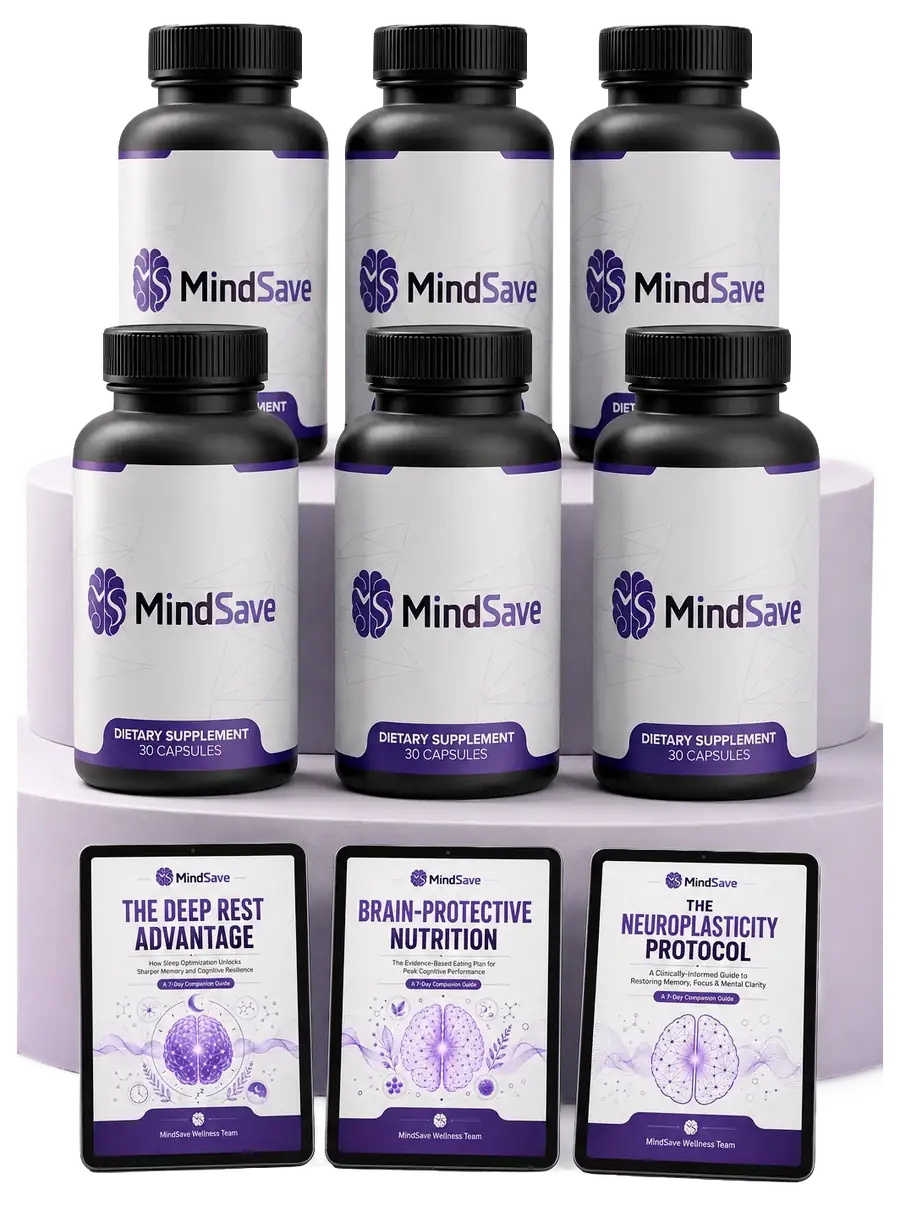
Order MindSave on the official website
One capsule a day, thirty to a bottle, eight ingredients named on the label.
$49 to $79 a bottle · 60 days to change your mind, and the bottles go back even if they are empty
Order MindSave On The Official WebsiteOne-time payment, no subscription · 60-day money-back guarantee · lot MIN-26/TH-5482