MindSave Official Website › MindSave Supplement Facts
MindSave Supplement Facts: Two Published Lists, Side By Side
Two documents published for MindSave say what is in the capsule and they do not agree. The sales page lists eight names and no amounts. The printed label artwork carries a Supplement Facts panel with amounts and a different formula, and its blend opens with caffeine. This desk prints both and asserts neither.
It then sets out what a panel is required to carry, and what to do about the gap between them.
What the MindSave label panel prints
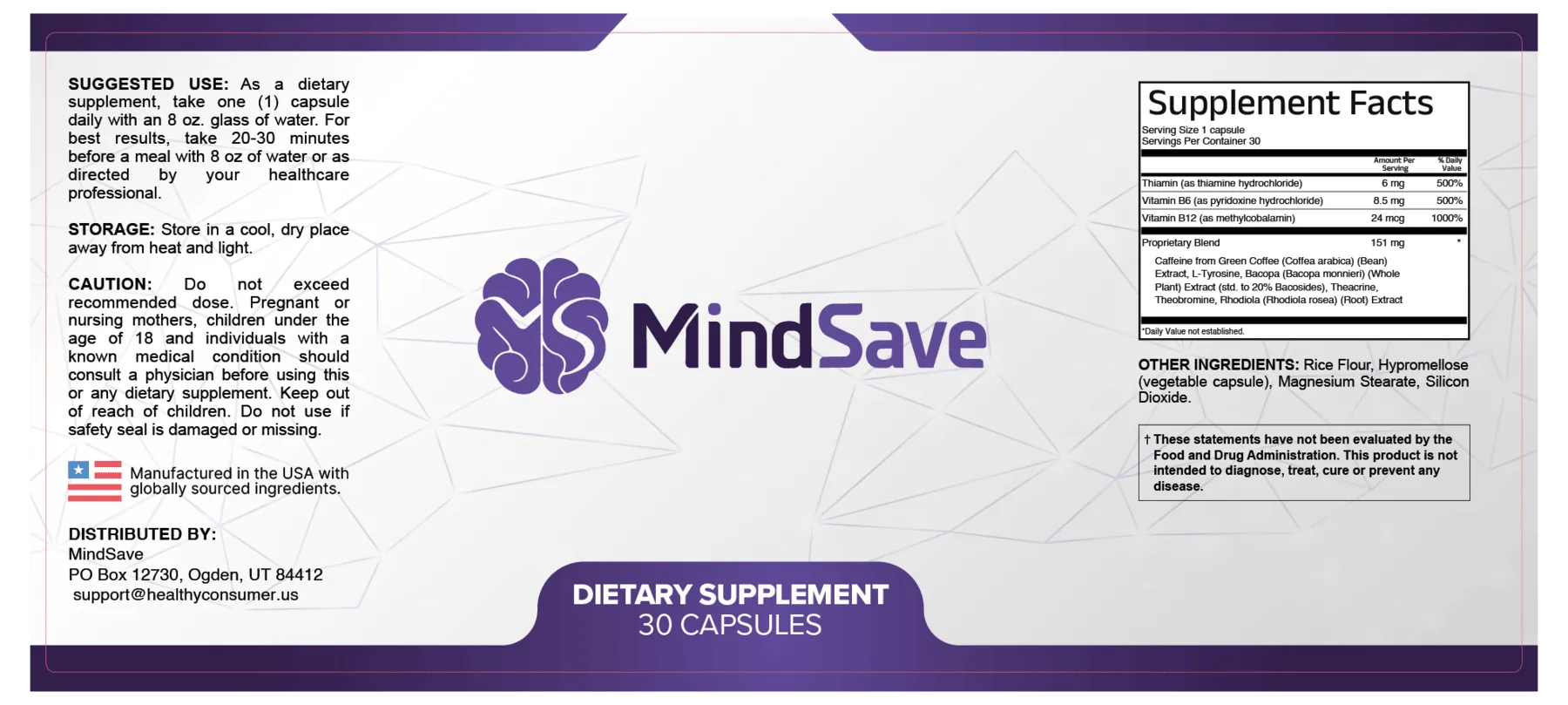
| Row | Amount per serving | % Daily Value |
|---|---|---|
| Thiamin (as thiamine hydrochloride) | 6 mg | 500% |
| Vitamin B6 (as pyridoxine hydrochloride) | 8.5 mg | 500% |
| Vitamin B12 (as methylcobalamin) | 24 mcg | 1000% |
| Proprietary Blend | 151 mg | Daily Value not established |
Proprietary blend contents, in the order the panel lists them: Caffeine from Green Coffee (Coffea arabica) (Bean) Extract, L-Tyrosine, Bacopa (Bacopa monnieri) (Whole Plant) Extract (std. to 20% Bacosides), Theacrine, Theobromine, Rhodiola (Rhodiola rosea) (Root) Extract. Other ingredients: Rice Flour, Hypromellose (vegetable capsule), Magnesium Stearate, Silicon Dioxide.
The difference is not academic and it is not small. Three names appear on both documents: vitamin B6, L-tyrosine and bacopa monnieri. The panel adds thiamin, vitamin B12, caffeine from green coffee, theacrine, theobromine and rhodiola. The sales page adds niacinamide, GABA, alpha GPC, phosphatidylserine and huperzine A.
Caffeine, theacrine and theobromine are stimulants, and only one of the two lists carries them. That is the sentence anyone avoiding stimulants needs, and it is the reason it also appears on the safety page and the suitability page rather than living only here.
This desk has not held a current bottle against that artwork. It cannot resolve which formula ships, it asserts neither as the contents, and it edits neither document. What it can give you is the next move: read the Supplement Facts panel on the bottle before the first capsule, and if it is not the formula you expected the 60-day guarantee takes the bottles back, empty ones included.
What a Supplement Facts panel must carry, and what MindSave shows
21 CFR 101.36 requires a quantitative amount by weight per serving for every dietary ingredient that is not a listed nutrient. Where a proprietary blend is used, the rule still requires the blend to be named as one, its ingredients listed in descending order by weight, and its total weight declared on the same line.
That is what the panel above does. It is also what an eight-name list with no figures does not do, which is the whole difference between the two documents and the reason this page exists.
This desk makes no allegation about compliance. It has not seen the physical panel on a current bottle, and a claim about a regulation needs the bottle in hand.
Published trial amounts, beside what the MindSave sales page gives
| Ingredient, as the sales page lists it | What studies used | What the sales page gives |
|---|---|---|
| Niacin (as Niacinamide) | The adult RDA is 16 mg NE for men and 14 mg NE for women, and the Tolerable Upper Intake Level for supplemental niacin is 35 mg a day. Niacinamide is the form that does not cause flushing. | Not published |
| Vitamin B6 | The adult RDA is 1.3 mg to age 50, then 1.7 mg for men and 1.5 mg for women, and the Tolerable Upper Intake Level is 100 mg a day from food and supplements together. Sensory neuropathy is documented at 1 to 6 g a day taken for 12 to 40 months. | Not published |
| GABA | 20 to 300 mg per dose in the human trials a systematic review could find, from single doses up to eight weeks. USP found no serious adverse events at 120 mg a day for 12 weeks. | Not published |
| L-Tyrosine | 2 g a day for five days in the combat-course trial, and 150 mg per kg of body weight as a single dose in the study of older adults. The positive findings cluster in short, acutely stressful or cognitively demanding situations rather than ordinary days. | Not published |
| Bacopa Monnieri | 300 to 450 mg a day of a standardised extract, and every trial in the systematic review ran for twelve weeks. The meta-analysis would not admit a trial shorter than twelve weeks at all. | Not published |
| Alpha GPC | 250 mg, 315 mg, 500 mg and 630 mg in the trials run in healthy adults. Europe's food-safety regulator has assessed 203.7 mg a day as a supplement level. | Not published |
| Phosphatidylserine | 300 mg a day - 100 mg three times daily - for twelve weeks in the 1991 trial that used the bovine-cortex form, and 300 or 600 mg a day for twelve weeks in the trial of the soy-derived form sold today, which found no difference from placebo on any measure. | Not published |
| Huperzine A | 200 or 400 MICROGRAMS twice a day for at least sixteen weeks in the largest placebo-controlled trial - micrograms, not milligrams, which is the smallest quantity on this panel by three orders of magnitude. That trial's primary analysis found no cognitive effect at the lower dose. | Not published |
How this MindSave label page is written
Four claims, and they are the ones a sceptical reader can audit in ten minutes:
- The bottle is the source. The eight names, the capsule count, the serving direction and the caution block come from the printed label and the supplier’s artwork. Prices, shipping lines, bonus titles and the guarantee wording come from the seller’s own order page, read on 19 September 2026.
- Research amounts live in a column of their own, headed “What studies used”, beside a column that says what the label prints. No sentence here moves a number from the first into the second.
- Sources are cited against their own population. Where a trial was run in people with a diagnosis, the sentence says so and the result is not carried across to a healthy reader.
- Corrections change the date. Write to [email protected] and the review date moves forward.
We earn when you buy. Themindsave is the USA Authorized MindSave Retailer named at the top of this page and this website makes money on orders placed through it. That is exactly why the note on what a list of eight names is worth, the three-star reviews and the plain statement that MindSave is not a treatment for anything are here: they are where our interest and yours pull apart. Order support on +1 (302) 200-3480 handles tracking, changes and refunds and is never a way to place an order; orders go through the checkout only.
Sources for the MindSave label analysis
- NIH Office of Dietary Supplements. Niacin: Fact Sheet for Health Professionals. https://ods.od.nih.gov/factsheets/Niacin-HealthProfessional/
- NIH Office of Dietary Supplements. Vitamin B6: Fact Sheet for Health Professionals. https://ods.od.nih.gov/factsheets/VitaminB6-HealthProfessional/
- Pase MP, Kean J, Sarris J, Neale C, Scholey AB, Stough C. The cognitive-enhancing effects of Bacopa monnieri: a systematic review of randomized, controlled human clinical trials. J Altern Complement Med. 2012;18(7):647-52. PMID 22747190. https://pubmed.ncbi.nlm.nih.gov/22747190/
- EFSA Panel on Nutrition, Novel Foods and Food Allergens (NDA); Turck D, Bohn T, Camara M, et al. Safety of L-alpha-glycerylphosphorylcholine (L-alpha-GPC) from soya phospholipids (lecithin) as a novel food pursuant to Regulation (EU) 2015/2283. EFSA J. 2026;24(5):e10008. PMID 42131868. https://pubmed.ncbi.nlm.nih.gov/42131868/
- Lee G, Choi S, Chang J, Choi D, Son JS, Kim K, Kim SM, Jeong S, Park SM. Association of L-alpha Glycerylphosphorylcholine With Subsequent Stroke Risk After 10 Years. JAMA Netw Open. 2021;4(11):e2136008. PMID 34817582. https://pubmed.ncbi.nlm.nih.gov/34817582/
- Kim HK, Park S, Kim SW, Park ES, Hong JY, Hong I, Baek MS. Association between L-alpha glycerylphosphorylcholine use and delayed dementia conversion: A nationwide longitudinal study in South Korea. J Prev Alzheimers Dis. 2025;12(4):100059. PMID 40155153. https://pubmed.ncbi.nlm.nih.gov/40155153/
- Rafii MS, Walsh S, Little JT, Behan K, Reynolds B, Ward C, Jin S, Thomas R, Aisen PS; Alzheimer's Disease Cooperative Study. A phase II trial of huperzine A in mild to moderate Alzheimer disease. Neurology. 2011;76(16):1389-94. PMID 21502597. https://pubmed.ncbi.nlm.nih.gov/21502597/
- Electronic Code of Federal Regulations. 21 CFR 101.36 - Nutrition labeling of dietary supplements. https://www.ecfr.gov/current/title-21/chapter-I/subchapter-B/part-101/subpart-C/section-101.36
- Electronic Code of Federal Regulations. 21 CFR 101.93 - Certain types of statements for dietary supplements. https://www.ecfr.gov/current/title-21/chapter-I/subchapter-B/part-101/subpart-F/section-101.93
- U.S. Food and Drug Administration. Structure/Function Claims. https://www.fda.gov/food/nutrition-food-labeling-and-critical-foods/structurefunction-claims
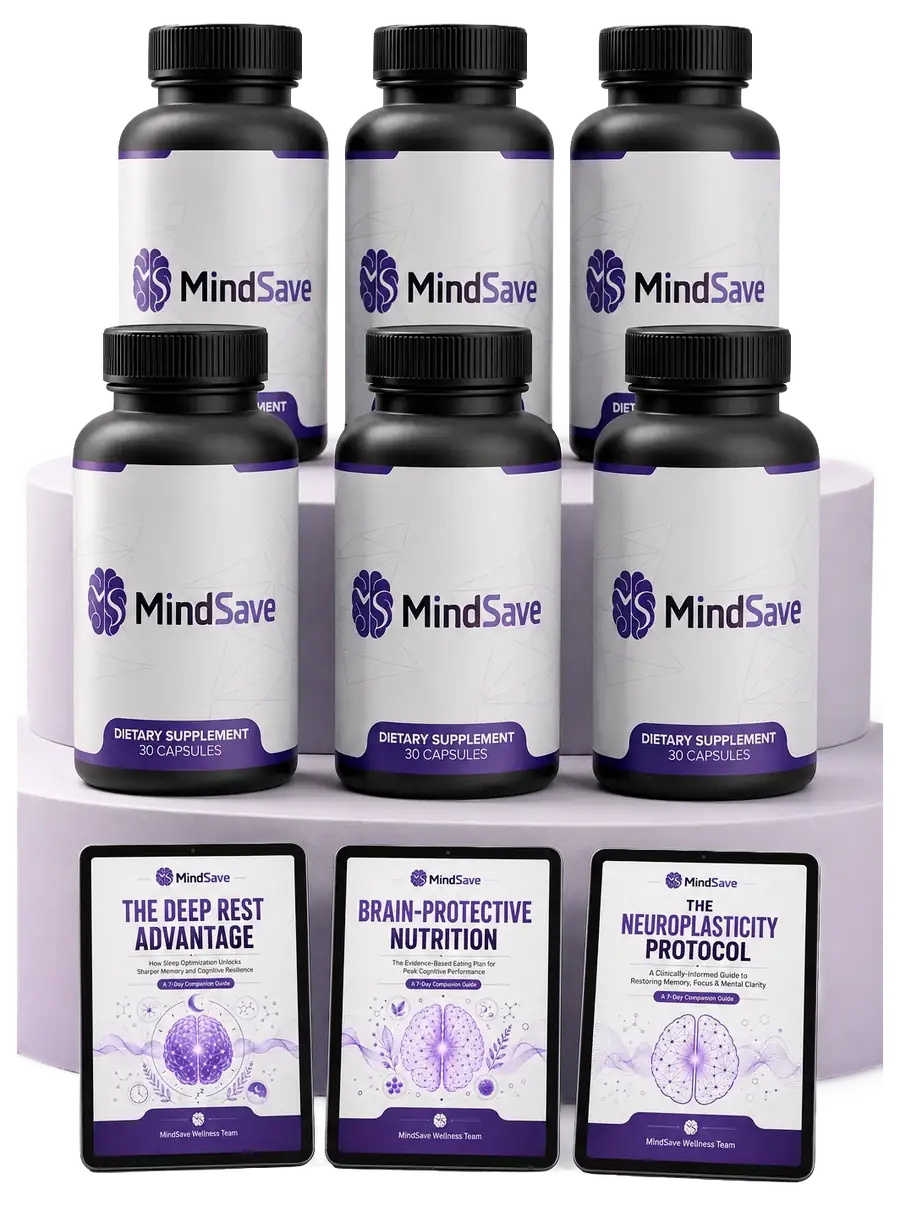
Order MindSave on the official website
One capsule a day, thirty to a bottle, eight ingredients named on the label.
$49 to $79 a bottle · 60 days to change your mind, and the bottles go back even if they are empty
Order MindSave On The Official WebsiteOne-time payment, no subscription · 60-day money-back guarantee · lot MIN-26/TH-5482