MindSave Official Website › Notebook › When Two MindSave Ingredient Lists Do Not Match
When Two MindSave Ingredient Lists Do Not Match
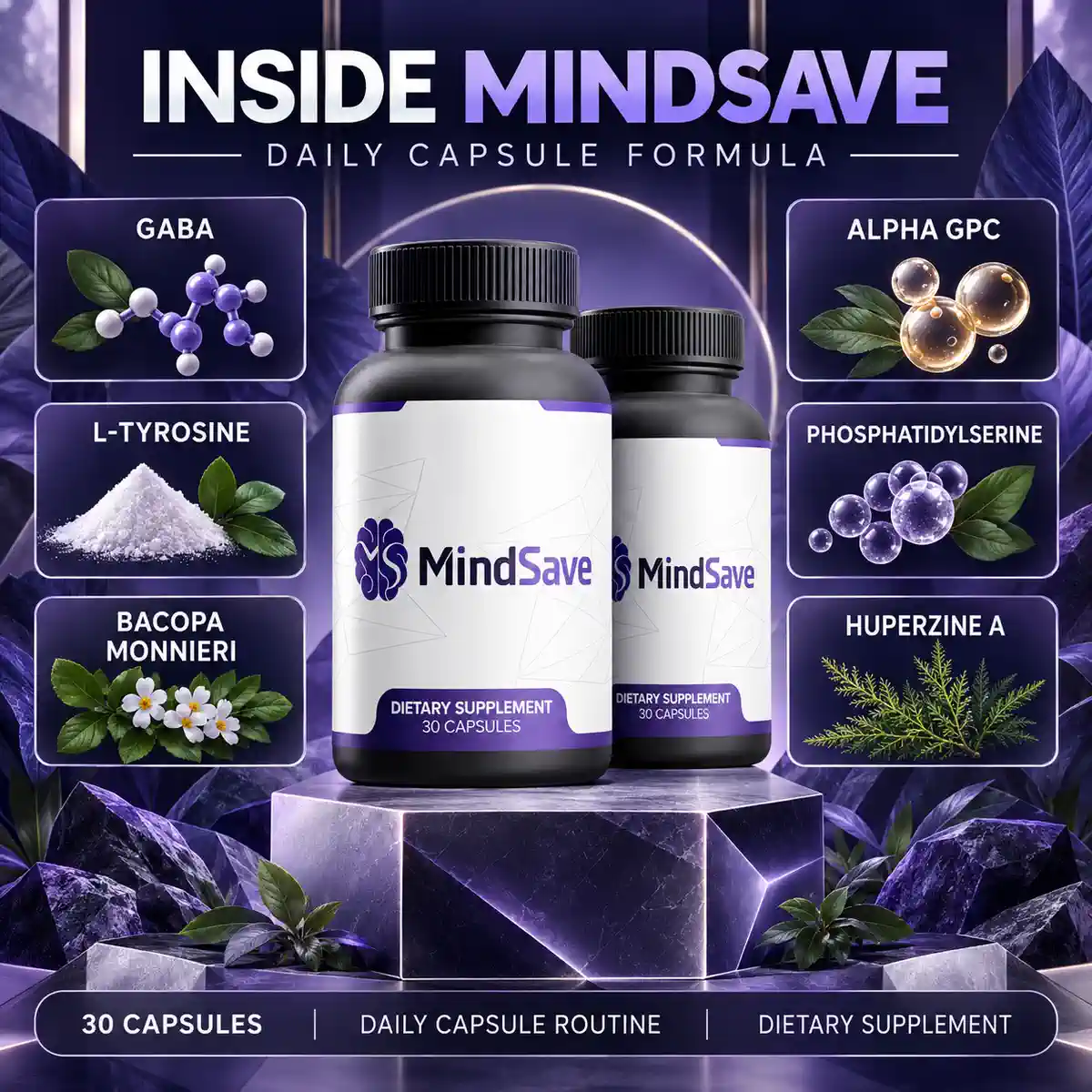
MindSave's sales page names eight ingredients without amounts. The supplied label artwork has a different formula with a Supplement Facts panel. Neither document alone proves what is in the bottle that reaches a particular buyer.
- Two records exist. The sales page and supplied panel artwork publish different ingredient lists.
- One list includes stimulants. The panel artwork includes caffeine, theacrine and theobromine; the sales-page list does not.
- Assert neither as the shipped formula. The desk cannot resolve the conflict before the bottle is received.
- Read the delivered panel. The bottle in hand is the document that can answer what a specific order contains.
Start with the disagreement, not a guess
A product page is normally where a buyer expects to learn a formula. On this MindSave listing, the published sales page names niacin, vitamin B6, GABA, L-tyrosine, bacopa, alpha GPC, phosphatidylserine and huperzine A. It gives no amount beside any of those names. The label artwork supplied with the pack shows a Supplement Facts panel, but the panel names a different set of materials. Three names overlap; several do not.
That is a conflict between two published records, not an invitation to choose the more attractive one. This desk does not know which formula a future order will contain. The responsible sentence is therefore limited: two lists exist, they do not agree, and the finished bottle must be checked before a buyer treats either list as the contents of a particular capsule.
The distinction protects an ordinary shopper from a surprisingly common error. An online ingredient list can be copied into a note, a review or a search snippet so often that it begins to look settled. Repetition does not reconcile two source documents. A claim about a finished product needs the document that travels with that finished product.
| Published record | What it says | What a buyer may conclude |
|---|---|---|
| Sales-page list | Eight named ingredients; no amount shown beside a name. | It identifies the seller's published names, not the amount in a shipped capsule. |
| Supplied panel artwork | A different formula with a Supplement Facts panel and a proprietary blend. | It shows what that artwork says, not a guarantee that every order has that formula. |
| Bottle received | Its own label, panel, lot and safety information. | It is the record to read before taking a capsule or relying on a formula claim. |
The sales page and artwork are both part of the supplied record. This desk asserts neither one as the contents of an uninspected order.
Why the stimulant difference matters before checkout
The difference is not merely a spelling variation. The panel artwork includes caffeine from green coffee bean extract, theacrine and theobromine, while the sales-page list does not. A person avoiding stimulants, managing sleep, pregnant or nursing, or considering medicines that affect blood pressure has a clear reason to slow down and inspect the bottle rather than assume the sales page settles the issue.
This is not a claim that every MindSave bottle contains stimulants, nor is it a claim that no bottle does. It is a narrow reading rule: when two published lists disagree and one list changes a safety-relevant decision, the uncertainty itself belongs in the decision. A buyer should not have to infer a stimulant exposure from a marketing headline or a single image.
The NIH and NCCIH consumer material cited here recommends discussing supplements and medicines with an appropriate health professional. That general advice is especially useful when the formula cannot be resolved from the pre-purchase record. A pharmacist can review a label in hand; a generic online list cannot answer a personal compatibility question.
- Do not use the sales-page list to rule stimulants in or out.
- Do not use the supplied panel artwork to declare that every order contains caffeine.
- If avoiding stimulants matters to you, read the delivered panel before the first capsule.
- Keep the product label with the medicine and supplement list you would show a pharmacist.
- Use the seller's posted return terms for a purchase problem; use clinical care for a health question.
The delivered panel is the confirmation step
A simple inspection on delivery resolves more than a long article can. Before opening the bottle, read the front for the product name and capsule count, then read the Supplement Facts panel and the suggested-use and caution blocks. Take a clear photograph of the panel and lot reference if you may need to ask the seller a question. That gives customer service and a clinician the same record rather than two descriptions of it.
The panel can answer a quantity question only for the bottle it is printed on. It does not turn a study of an ingredient into a study of the finished formula, and it does not make the formula suitable for every person. It does, however, give a buyer a firmer basis for deciding whether the delivered product matches what they expected before the first capsule is used.
If a listing and a delivered bottle conflict, preserve the order details and use the official customer-service route for the purchase question. Avoid treating a search result, a social post or another retailer's image as a substitute for the label in hand. Those sources may describe a different batch, edition or product.
- Read the product name, capsule count and lot on the bottle received.
- Read the entire Supplement Facts panel, including any proprietary-blend line.
- Check the suggested use, storage and caution text before taking a capsule.
- Photograph the label and retain the order confirmation if a question remains.
- Ask a pharmacist or clinician about medicines, symptoms or health history rather than asking a sales page to decide them.

Research context has a different job
Published ingredient research can help a reader understand what a study asked. It does not repair a formula conflict. A study has a named material, dose, duration, participant group and endpoint. Until the actual bottle's panel is read, a shopper cannot responsibly match all of those elements to MindSave. That is why this site keeps research figures beside their sources rather than presenting them as the amount in a capsule.
The same caution applies to a product-support phrase. The seller's phrases about memory, focus and everyday cognitive performance describe how the listing is marketed. They are not a clinical outcome for a particular person. Federal labelling rules and consumer guidance are useful here because they bring the reader back to concrete facts: what is stated, what is measured, and what is not established by the record available before a purchase.
A fair research question can wait until the formula is known. First establish the product in hand. Then, if you want to read a paper, compare its named ingredient, amount, duration and population with the label carefully. If any of those details remains unknown, the honest conclusion is that the comparison is incomplete rather than positive or negative.
| Information type | Useful question | What it cannot answer alone |
|---|---|---|
| Delivered label | What does this bottle say it contains and how is it directed? | Whether it will produce a particular health outcome. |
| Ingredient study | What did researchers test in a defined setting? | Whether an unresolved finished formula matches that study. |
| Seller claim | How is the product presented to shoppers? | The likelihood, timing or size of an individual result. |
A source stays useful when it is not asked to do a different source's job.
A clear rule before you order
There is a practical, non-dramatic way to handle the conflict: decide what information you need before buying. If a stimulant-free formula, an exact amount or a finished-product test report is essential to your decision, the current pre-purchase documents do not provide a single resolved answer. Waiting for a clearer record is a valid choice. No label article can make missing or conflicting information disappear.
If you do purchase, treat the label on the delivered bottle as a checkpoint, not a formality. Compare it with your expectation while the seller's 60-day purchase terms are still relevant. Follow the delivered direction rather than a routine invented from a blog, and stop the experiment in favor of professional advice if a medicine, health condition or concerning symptom is part of the picture.
That approach is deliberately buyer-centred. It neither labels the product unsafe nor supplies certainty the record does not have. It gives a shopper an order of operations: identify the conflict, inspect the bottle, ask a precise question, and choose only from facts that apply to the product in hand.
A note on what this is. MindSave is a dietary supplement, not a medicine. Nothing in this post describes it as a treatment for dementia, Alzheimer’s disease or mild cognitive impairment, and no supplement is currently recommended for preventing cognitive decline. Memory or thinking that is changing in a way that worries you is a reason to be assessed by a clinician, not a reason to start a capsule.
Sources cited in this article
- Electronic Code of Federal Regulations. 21 CFR 101.36 - Nutrition labeling of dietary supplements. https://www.ecfr.gov/current/title-21/chapter-I/subchapter-B/part-101/subpart-C/section-101.36
- U.S. Food and Drug Administration. Label Claims for Conventional Foods and Dietary Supplements. https://www.fda.gov/food/nutrition-food-labeling-and-critical-foods/label-claims-conventional-foods-and-dietary-supplements
- Federal Trade Commission. Health Products Compliance Guidance. https://www.ftc.gov/business-guidance/resources/health-products-compliance-guidance
- National Center for Complementary and Integrative Health, National Institutes of Health. Know the Science: How Medications and Supplements Can Interact. https://www.nccih.nih.gov/health/know-science/how-medications-supplements-interact
- National Center for Complementary and Integrative Health, National Institutes of Health. 7 Things To Know About Dietary Supplements for Cognitive Function, Dementia, and Alzheimer's Disease. https://www.nccih.nih.gov/health/tips/things-to-know-about-dietary-supplements-for-cognitive-function-dementia-and-alzheimers-disease
- MedlinePlus, U.S. National Library of Medicine. Dietary Supplements. https://medlineplus.gov/dietarysupplements.html
MindSave, on the official website
One capsule a day, thirty to a bottle, eight ingredients named on the label. Sixty days to change your mind, and the bottles go back even if they are empty.
Order MindSave