MindSave Official Website › Notebook › One Capsule Daily Is a Direction, Not a Dosing Experiment
One Capsule Daily Is a Direction, Not a Dosing Experiment
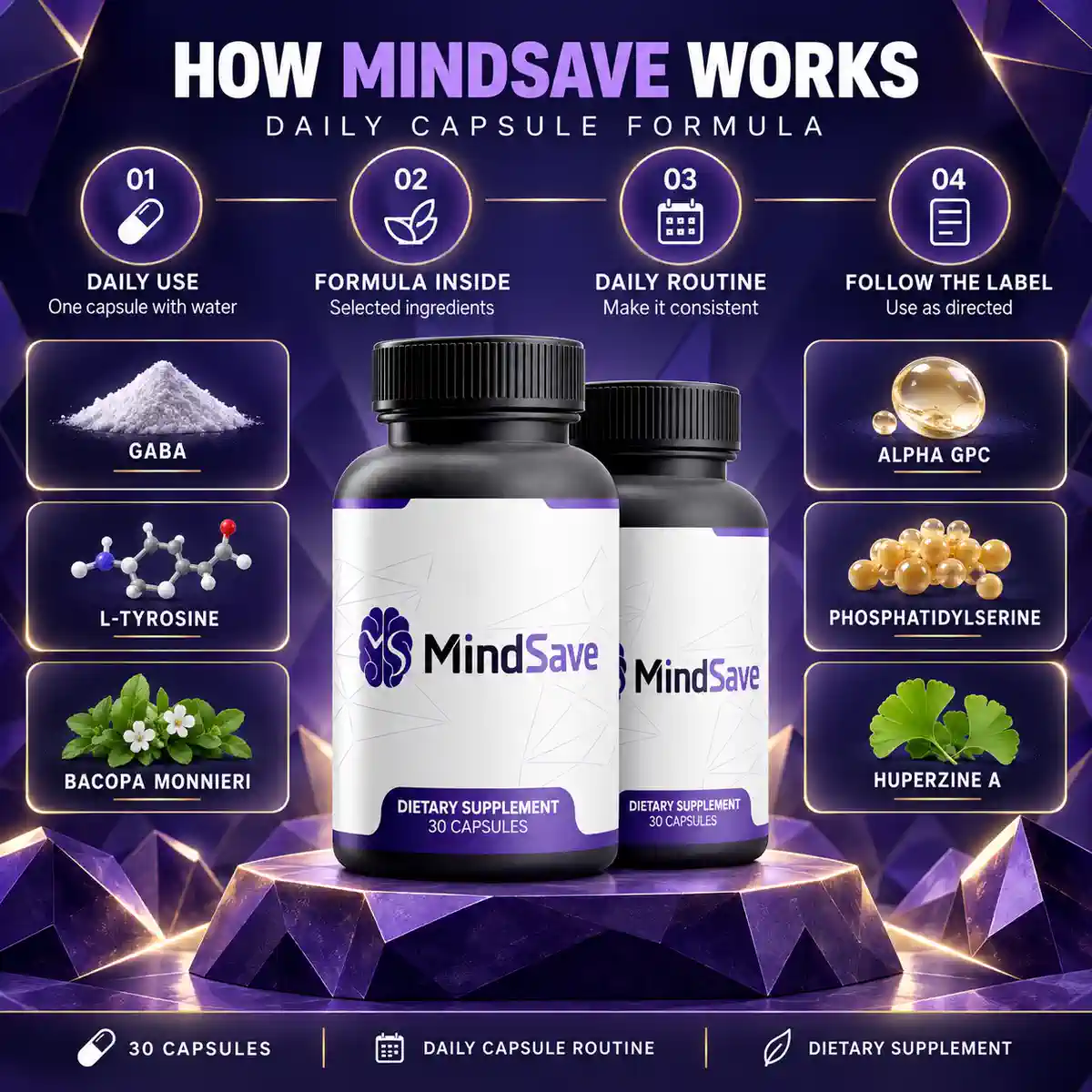
MindSave's supplied pack describes one capsule daily with 6 to 8 ounces of water; the label artwork says an 8-ounce glass and suggests taking it before a meal. That direction is a routine instruction, not an invitation to change the amount, catch up a missed day or self-manage a health concern.
- One capsule daily is the published routine. A 30-capsule bottle represents 30 days when used as directed.
- The water wording has a small source difference. The pack says 6 to 8 ounces; the artwork says an 8-ounce glass.
- Do not invent a catch-up plan. The available product record does not give a special missed-dose instruction.
- Use the label in hand for safety questions. A pharmacist or clinician can assess medicines and health history; a general routine page cannot.
Read the direction as written
The supplied MindSave pack describes the routine as one capsule daily with 6 to 8 ounces of water. The label artwork uses slightly different wording: one capsule daily with an 8-ounce glass, and for best results 20 to 30 minutes before a meal or as directed by a healthcare professional. The shared point is the once-daily instruction. The difference in water wording is worth quoting accurately rather than smoothing into a more precise rule than either source gives.
A direction tells a buyer how the seller describes ordinary use of the product. It does not answer what an ingredient amount is, because the sales-page list does not publish amounts for its eight names. It does not predict a cognitive result, and it does not tell a reader how to adapt the product around another supplement, a prescription medicine, pregnancy, a procedure or a new symptom.
This boundary matters because daily routines can feel more authoritative than they are. A calendar reminder can help someone follow a direction; it cannot turn a retail instruction into a personal treatment plan. Keep the question small and factual: what does the bottle say to do, and does that direction make sense alongside the rest of your actual circumstances?
| Published detail | What it tells a buyer | What it does not tell a buyer |
|---|---|---|
| One capsule daily | The routine is once per day. | Whether a different amount is appropriate for you. |
| 30 capsules per bottle | One bottle is a 30-day supply when used as directed. | Whether 30 days is enough to judge a health outcome. |
| 6 to 8 oz / 8 oz water wording | Use water with the capsule as the supplied sources direct. | A personalized fluid, food or timing plan. |
| Before a meal wording on artwork | The artwork's suggested timing. | Permission to ignore cautions, medicine interactions or a clinician's advice. |
The table repeats the supplied pack and label language. It does not create instructions for a missed dose or a medical condition.
A bottle count is useful, but it is not evidence
Thirty capsules and one capsule daily make the arithmetic plain: one bottle covers 30 days if it is used as directed. That is a purchase and planning fact. It can help a buyer compare the two-, three- and six-bottle offers, storage space and the 60-day return window. It cannot tell a buyer that a particular effect should happen in 30 days, or that a longer supply changes the evidence for an ingredient list.
The seller's consistency language and a shopper's own hopes are different kinds of information. A product page may encourage a routine; a clinical outcome would require a relevant study of a defined formula, amount and group. This site has no product-specific trial in the supplied pack. Treat a bottle count as a count and a commercial guarantee as a purchase term, not as a forecast about memory or concentration.
That distinction also makes it easier to make a calm decision. You can decide whether a 30-day bottle fits your budget and schedule without forcing the choice to answer a medical question. If the important question is a change in memory, thinking or daily functioning, that question belongs with a clinician rather than with a bottle's countdown.
- Use 30 capsules divided by one per day to understand the bottle's stated supply.
- Compare current pack totals and return terms at checkout rather than relying on an old screenshot.
- Do not treat a larger pack as proof that a product has more evidence.
- Do not treat a routine as a diagnostic test for a memory concern.
- Keep the order record separate from the questions that need clinical advice.
Do not turn missing instructions into new instructions
The available MindSave pack does not give a special instruction for a missed day, a double dose, taking two capsules together or changing the timing around medicines. Silence on those questions is not a hidden recommendation. A reader should not manufacture a catch-up schedule from the fact that the product is marketed as once daily, particularly where the ingredient information is already unresolved between the sales page and the supplied label artwork.
The right next source depends on the question. For a simple order or label question, use the current official product information or seller contact route. For a medicine interaction, pregnancy, nursing, a planned procedure, a known condition or a troubling symptom, use a pharmacist or clinician who can see the whole picture. A generic article cannot safely compare an unknown personal regimen with an unresolved formula.
Consumer guidance on supplements repeatedly makes the same practical point: bring the label and a complete medicine-and-supplement list to the conversation. Names, directions and panel amounts on the bottle in hand are useful inputs. A confident adjustment based on a blog paragraph is not.
- Follow the current product direction printed on the bottle you receive.
- Do not add a second capsule to compensate for an omitted day unless a qualified professional tells you to do so.
- Read the safety and storage text before first use, not only the front label.
- Keep a current list of all medicines and supplements for a pharmacist or clinician.
- Seek assessment for new, worsening or worrying cognitive changes rather than extending a self-directed experiment.
Use a small routine record, not a result diary
If you choose to follow the once-daily direction, a short record can keep the purchase facts straight without turning ordinary fluctuations into a conclusion. Record the date, the bottle label, the serving direction, other products in use and any question you want to ask a professional. Those details are concrete and useful if you later need to compare the delivered formula with the listing or speak with a pharmacist.
What a short record should not do is grade every day as evidence for or against a product claim. Sleep, stress, illness, work demands, food and many other ordinary factors affect how a person feels and functions. A diary can notice a pattern, but it cannot identify its cause. That is why concerning changes should be assessed rather than explained by a supplement routine.
The same restraint applies to online reviews. A reader may find another person's routine useful as a story, but it does not establish the formula, dose or result for a new buyer. Keep the product facts, the personal observations and the professional questions in separate columns rather than allowing one to stand in for the other.
| Keep | Why it is useful | Do not infer |
|---|---|---|
| Bottle label and lot | Identifies the item actually received. | That another online list necessarily matches it. |
| Direction and start date | Records the routine you followed. | That a routine proves a result or cause. |
| Medicine and supplement list | Gives a clinician or pharmacist context. | That a general web page can clear an interaction. |
| A specific question | Makes follow-up with the seller or clinician clear. | That an unanswered question has a favourable answer. |
A modest record supports a better conversation. It is not a substitute for a clinical assessment.

Choose the next step from the right question
The once-daily direction is enough to describe the seller's routine. It is not enough to resolve the two-list conflict, determine ingredient amounts before delivery, decide medication compatibility or make a claim about a health result. A buyer who needs one of those answers has not failed to follow the direction; they have reached a different question that needs a different source.
For a purchase question, confirm the current pack option, price, guarantee and delivered label. For a safety or medication question, ask a pharmacist or clinician. For a new or worrying memory concern, seek assessment rather than using a routine as a reason to postpone care. These paths can coexist without turning a dietary supplement into a promise or a diagnosis.
That is the reader-first use of a direction: take it literally, keep its scope small, and let the unanswered questions remain unanswered until the appropriate person or document can answer them. A clear boundary is more useful than an invented dosing rule.
A note on what this is. MindSave is a dietary supplement, not a medicine. Nothing in this post describes it as a treatment for dementia, Alzheimer’s disease or mild cognitive impairment, and no supplement is currently recommended for preventing cognitive decline. Memory or thinking that is changing in a way that worries you is a reason to be assessed by a clinician, not a reason to start a capsule.
Sources cited in this article
- National Center for Complementary and Integrative Health, National Institutes of Health. 7 Things To Know About Dietary Supplements for Cognitive Function, Dementia, and Alzheimer's Disease. https://www.nccih.nih.gov/health/tips/things-to-know-about-dietary-supplements-for-cognitive-function-dementia-and-alzheimers-disease
- National Center for Complementary and Integrative Health, National Institutes of Health. Know the Science: How Medications and Supplements Can Interact. https://www.nccih.nih.gov/health/know-science/how-medications-supplements-interact
- MedlinePlus, U.S. National Library of Medicine. Dietary Supplements. https://medlineplus.gov/dietarysupplements.html
- U.S. Food and Drug Administration. Label Claims for Conventional Foods and Dietary Supplements. https://www.fda.gov/food/nutrition-food-labeling-and-critical-foods/label-claims-conventional-foods-and-dietary-supplements
- Electronic Code of Federal Regulations. 21 CFR 101.36 - Nutrition labeling of dietary supplements. https://www.ecfr.gov/current/title-21/chapter-I/subchapter-B/part-101/subpart-C/section-101.36
MindSave, on the official website
One capsule a day, thirty to a bottle, eight ingredients named on the label. Sixty days to change your mind, and the bottles go back even if they are empty.
Order MindSave