MindSave Official Website › Notebook › Micrograms And Milligrams: Why One Panel Can Span Three Orders Of Magnitude
Micrograms And Milligrams: Why One Panel Can Span Three Orders Of Magnitude
Bacopa is studied in hundreds of milligrams. Huperzine A is studied in hundreds of micrograms. That is a thousand-fold difference between two names sitting one line apart, and nothing about a list of names shows it.
- A thousand-fold spread. Bacopa's trials run 300 to 450 mg a day. Huperzine A's run 200 to 400 micrograms twice a day.
- A microgram is a thousandth of a milligram. Writing mg where mcg belongs is not a typo, it is a thousand-fold error.
- Two federal upper limits. Niacin and vitamin B6 both have them, and they are the only two numbers on this shelf you can genuinely overdo by stacking.
- A list of names looks identical either way. That is the honest limit of an ingredient list without amounts.
Three orders of magnitude, one panel
Take two ingredients that appear on the same cognition labels all the time. Bacopa monnieri is trialled at 300 to 450 mg a day of a standardised extract. Huperzine A is trialled at 200 or 400 micrograms twice a day.
Four hundred milligrams against four hundred micrograms is a factor of a thousand. Both names occupy one line on a label and both take up about the same amount of ink.
This is why the unit matters so much in this corner of the shelf, and why nothing on this website ever writes a milligram figure for huperzine A. A reader who saw “400 mg” would be reading a number a thousand times larger than anything any trial has used.
| Ingredient | What studies used |
|---|---|
| Niacin (as Niacinamide) | The adult RDA is 16 mg NE for men and 14 mg NE for women, and the Tolerable Upper Intake Level for supplemental niacin is 35 mg a day. Niacinamide is the form that does not cause flushing. |
| Vitamin B6 | The adult RDA is 1.3 mg to age 50, then 1.7 mg for men and 1.5 mg for women, and the Tolerable Upper Intake Level is 100 mg a day from food and supplements together. Sensory neuropathy is documented at 1 to 6 g a day taken for 12 to 40 months. |
| GABA | 20 to 300 mg per dose in the human trials a systematic review could find, from single doses up to eight weeks. USP found no serious adverse events at 120 mg a day for 12 weeks. |
| L-Tyrosine | 2 g a day for five days in the combat-course trial, and 150 mg per kg of body weight as a single dose in the study of older adults. The positive findings cluster in short, acutely stressful or cognitively demanding situations rather than ordinary days. |
| Bacopa Monnieri | 300 to 450 mg a day of a standardised extract, and every trial in the systematic review ran for twelve weeks. The meta-analysis would not admit a trial shorter than twelve weeks at all. |
| Alpha GPC | 250 mg, 315 mg, 500 mg and 630 mg in the trials run in healthy adults. Europe's food-safety regulator has assessed 203.7 mg a day as a supplement level. |
| Phosphatidylserine | 300 mg a day - 100 mg three times daily - for twelve weeks in the 1991 trial that used the bovine-cortex form, and 300 or 600 mg a day for twelve weeks in the trial of the soy-derived form sold today, which found no difference from placebo on any measure. |
| Huperzine A | 200 or 400 MICROGRAMS twice a day for at least sixteen weeks in the largest placebo-controlled trial - micrograms, not milligrams, which is the smallest quantity on this panel by three orders of magnitude. That trial's primary analysis found no cognitive effect at the lower dose. |
The middle column describes the studies it came from. It is not a description of any product, and no figure here should be read as a recommendation.
Four units, and what each one means
Most confusion about supplement quantities is confusion about units rather than arithmetic, and four different units can appear on one cognition label.
| Unit | What it is | Where it turns up on this panel |
|---|---|---|
| gram (g) | A thousand milligrams. | The combat-course tyrosine dose was 2 g a day (Deijen 1999), which is 2,000 mg. |
| milligram (mg) | A thousandth of a gram. | Bacopa’s trials at 300 to 450 mg a day, and the 203.7 mg a day of alpha-GPC Europe assessed as a supplement level. |
| microgram (mcg) | A thousandth of a milligram. | Huperzine A, at 200 or 400 mcg twice a day in the largest placebo-controlled trial, run in people with a dementia diagnosis. |
| mg NE | Milligrams of niacin equivalents, which counts the niacin the body makes from tryptophan as well as the niacin eaten. | The niacin RDA is written in NE; the upper limit is not, because it applies to supplemental niacin rather than to the diet. |
Units, not doses. This row set exists so that a figure read somewhere else can be placed on the right scale before anyone decides what it means.
The one that does the damage is the third. Writing mg where mcg belongs moves a figure by a factor of a thousand, and on a shelf where a reader half-expects milligrams, the error reads as plausible. It is why no page here prints a milligram figure for huperzine A.
What a list of names can still do
It is easy to read the above as an argument that an ingredient list without amounts is worthless. It is not, and the more useful framing is to ask what questions the list can still answer.
Three of them it answers completely. Whether something already in your cupboard is on it. Whether anything on it is worth raising with a prescriber. And whether this is even the kind of formula you were looking for, because eight names describe a shape even when they describe no quantity.
One it cannot answer at all: how this bottle compares with a published trial. That question needs numbers and the list has none.
The two numbers you can actually overdo
There is one place where quantity on a cognition label matters to safety rather than to efficacy, and it is the vitamins.
Supplemental niacin has a tolerable upper intake level of 35 mg a day for adults. Vitamin B6 has one of 100 mg a day from food and supplements together, and long-term intakes well above it are linked to sensory nerve damage.
Those are the only two figures on a typical cognition panel that a shopper can push past by stacking products, and the stacking is easy: a multivitamin, a B-complex and a focus formula can all carry B6 without any of them being unreasonable on its own.
If a label prints its amounts, add them up. If it does not, count the products that do, because those you can read. That is the practical answer and it does not require the missing numbers at all.
The safety page on this website names the three groups of medicine worth raising, and the label page sets out what a Supplement Facts panel is required to carry.
One ingredient, two different scales
Scale is not only a difference between ingredients. One name here means two different quantities depending on which shelf it stands on, and alpha-GPC is that name.
Europe’s food-safety regulator assessed 203.7 mg a day as the maximum use level for alpha-GPC from soya phospholipids in food supplements, which works out at 82.5 mg a day of choline, for people over three years old including during pregnancy and lactation. Its conclusion was that the novel food does not raise safety concerns under those conditions of use.
In South Korea the same compound is a licensed prescription medicine, at amounts several times that supplement figure. The safety literature sits at that end, and it has two published sides which travel together.
A 2021 cohort study followed more than twelve million South Koreans aged 50 and over with no prior stroke or Alzheimer’s disease, of whom 108,877 were prescribed alpha-GPC between 2006 and 2008, out to 2018. It found a higher ten-year rate of stroke among the people prescribed it, rising with the number of months prescribed. The authors could not attribute that to the compound, and the paper asks for work on a possible mechanism rather than establishing one.
A 2025 study of the same national database points the other way. Among 508,107 patients newly diagnosed with mild cognitive impairment between 2013 and 2016, those prescribed alpha-GPC had a lower rate of progression to Alzheimer’s dementia and to vascular dementia, and stroke risk fell among those who did not progress. It is observational too, and its population is a diagnosed one.
Neither settles anything, and that is the point about scale rather than about alpha-GPC. Two very large studies of a prescription medicine, given to people already diagnosed with something, say nothing about a capsule whose amount is not printed. The figure that belongs to the supplement conversation is the one Europe assessed.
What a panel has to print, and what a sales page does not
There is a rule about all of this, and reading it is the fastest way to tell which kind of document you are holding.
21 CFR 101.36 requires the quantitative amount by weight per serving of every dietary ingredient that is not one of the listed nutrients. A proprietary blend may leave the individual amounts out, and even then it has to be identified as a proprietary blend, its ingredients listed in descending order of predominance by weight, and its total weight declared on the same line. The rule carries its own floor: a number appears somewhere.
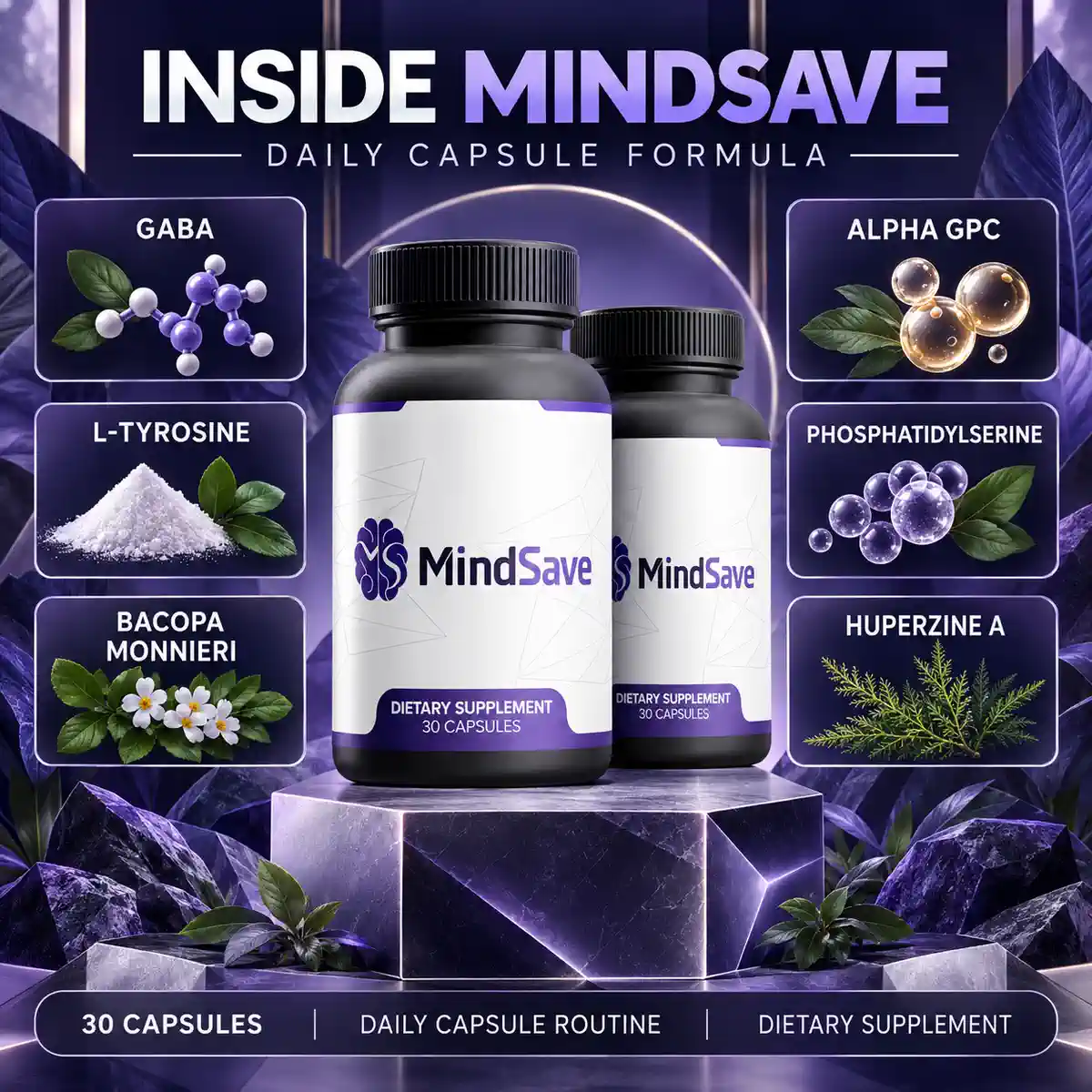
A sales page is not a Supplement Facts panel and nothing asks it to be one, which is why the precise sentence matters. The sales page for this product prints no amount for any of the eight names it lists. The printed label artwork is a different document, it carries a complete panel with milligrams on it, and the formula it describes is not the same list of names.
This desk cannot tell you which bottle ships and asserts neither list as the contents. Worth saying before any of the arithmetic above: one of the two published lists contains caffeine, along with theacrine and theobromine, which matters to anyone avoiding stimulants long before it matters to anyone comparing quantities.
Both lists sit side by side on the label page. The panel on the bottle that arrives is what settles it, and the sixty-day guarantee is the recourse if it is not what you expected.
A note on what this is. MindSave is a dietary supplement, not a medicine. Nothing in this post describes it as a treatment for dementia, Alzheimer’s disease or mild cognitive impairment, and no supplement is currently recommended for preventing cognitive decline. Memory or thinking that is changing in a way that worries you is a reason to be assessed by a clinician, not a reason to start a capsule.
Sources cited in this article
- NIH Office of Dietary Supplements. Niacin: Fact Sheet for Health Professionals. https://ods.od.nih.gov/factsheets/Niacin-HealthProfessional/
- NIH Office of Dietary Supplements. Vitamin B6: Fact Sheet for Health Professionals. https://ods.od.nih.gov/factsheets/VitaminB6-HealthProfessional/
- Deijen JB, Wientjes CJ, Vullinghs HF, Cloin PA, Langefeld JJ. Tyrosine improves cognitive performance and reduces blood pressure in cadets after one week of a combat training course. Brain Res Bull. 1999;48(2):203-9. PMID 10230711. https://pubmed.ncbi.nlm.nih.gov/10230711/
- Pase MP, Kean J, Sarris J, Neale C, Scholey AB, Stough C. The cognitive-enhancing effects of Bacopa monnieri: a systematic review of randomized, controlled human clinical trials. J Altern Complement Med. 2012;18(7):647-52. PMID 22747190. https://pubmed.ncbi.nlm.nih.gov/22747190/
- EFSA Panel on Nutrition, Novel Foods and Food Allergens (NDA); Turck D, Bohn T, Camara M, et al. Safety of L-alpha-glycerylphosphorylcholine (L-alpha-GPC) from soya phospholipids (lecithin) as a novel food pursuant to Regulation (EU) 2015/2283. EFSA J. 2026;24(5):e10008. PMID 42131868. https://pubmed.ncbi.nlm.nih.gov/42131868/
- Lee G, Choi S, Chang J, Choi D, Son JS, Kim K, Kim SM, Jeong S, Park SM. Association of L-alpha Glycerylphosphorylcholine With Subsequent Stroke Risk After 10 Years. JAMA Netw Open. 2021;4(11):e2136008. PMID 34817582. https://pubmed.ncbi.nlm.nih.gov/34817582/
- Kim HK, Park S, Kim SW, Park ES, Hong JY, Hong I, Baek MS. Association between L-alpha glycerylphosphorylcholine use and delayed dementia conversion: A nationwide longitudinal study in South Korea. J Prev Alzheimers Dis. 2025;12(4):100059. PMID 40155153. https://pubmed.ncbi.nlm.nih.gov/40155153/
- Rafii MS, Walsh S, Little JT, Behan K, Reynolds B, Ward C, Jin S, Thomas R, Aisen PS; Alzheimer's Disease Cooperative Study. A phase II trial of huperzine A in mild to moderate Alzheimer disease. Neurology. 2011;76(16):1389-94. PMID 21502597. https://pubmed.ncbi.nlm.nih.gov/21502597/
- Electronic Code of Federal Regulations. 21 CFR 101.36 - Nutrition labeling of dietary supplements. https://www.ecfr.gov/current/title-21/chapter-I/subchapter-B/part-101/subpart-C/section-101.36
MindSave, on the official website
One capsule a day, thirty to a bottle, eight ingredients named on the label. Sixty days to change your mind, and the bottles go back even if they are empty.
Order MindSave